

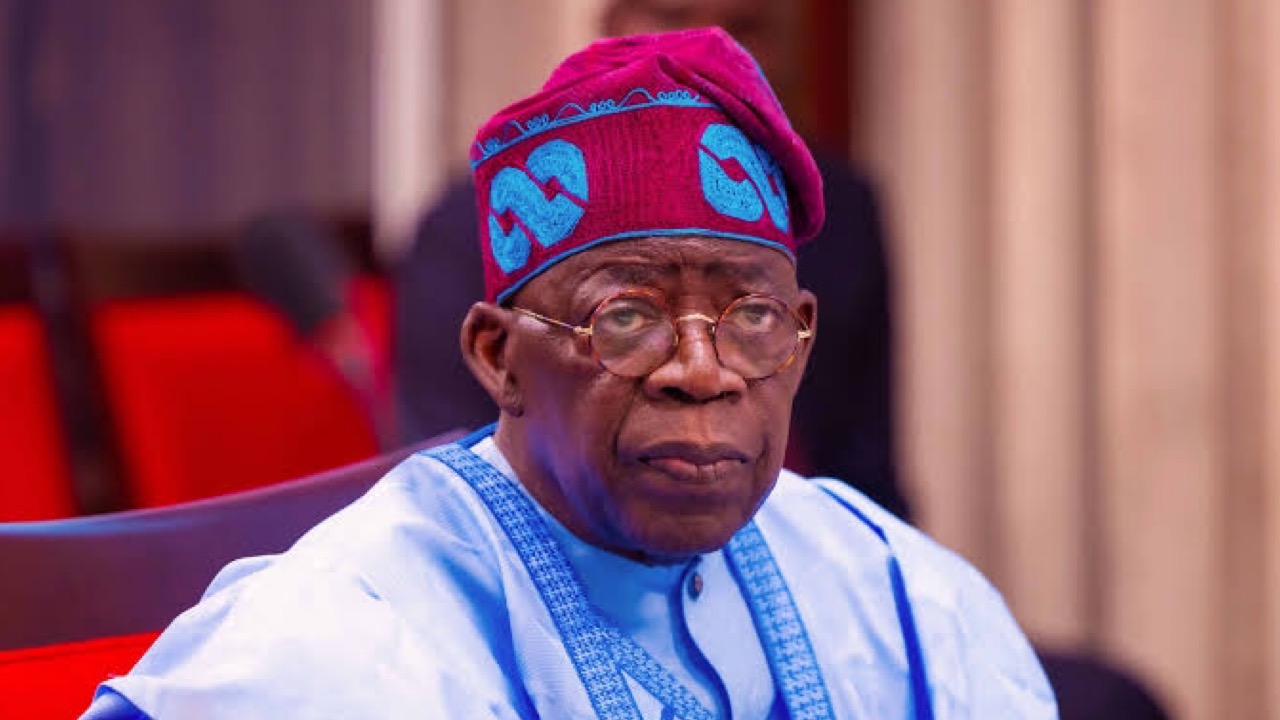

President Bola Tinubu is planning to meet with the service chiefs to discuss the rising killings in Plateau, Benue and other parts of the country on his return to Abuja from his two-week working visit to Paris, the French capital.
Tinubu returned to Abuja on Monday night after spending 18 days on a visit and retreat in Paris and London.
The Air Force 001 aircraft conveying the President landed at the Nnamdi Azikiwe International Airport, Abuja at 09:50pm on Monday, the State House media office announced.
Since April 2, when he travelled, more than 120 locals have been killed by armed assailants.
Several homes have been burnt and 3,000 persons displaced despite the deployment of security forces.
In Benue, at least 56 people were killed in Logo and Gbagir after twin assaults blamed on armed herders.
Multiple sources said the President was concerned by the security situation and would immediately meet with the service chiefs and the National Security Adviser, Nuhu Ribadu, over the development.
On Monday, a top functionary privy to the development confirmed to The PUNCH that the security meeting would review the rising violence and the measures to contain it.
“The President will certainly meet the service chiefs to review the security situation across the country and the flash point of Plateau, Benue and Borno. He has been getting security briefings while away and giving directives to the security chiefs. So, he will meet his security chiefs and ministers too,’’ he affirmed.
This came as the Presidency blamed state governors for the mounting cases of killings nationwide, especially the recent incidents in Plateau, Benue and Enugu States.
It cited the governors’ poor funding of security outfits in their states despite receiving humongous security votes.
Special Adviser to the President on Policy Communication, Daniel Bwala, stated this when he appeared on TVC’s Beyond the Headlines show with Nifemi Oguntoye Monday evening.
Bwala said, “What we are finding, very sadly, is that there are some states where the governors give N20m to the SSS, N20m to the police, and N20m to the army as monthly allocation for fighting insecurity. And you hear their security vote is between N1bn, N2bn and N3bn. Where are we going?”
Commenting on the clamour for state police, Bwala argued the demand masks weak local governance in the states.
He maintained that the bloodshed could be curbed “within the laws and resources they (governors) already control,” if the state executives quit tokenism and fund the federal agencies in their domain.
Bwala stated, “There are people who still believe, within the present framework of the security architecture of the state, that we can deal with insecurity if we understand what it takes to do that.
“What does it take to do that? In every state, for example, there are the SSS, police, military, and paramilitary. Then, every state has the right to create a quasi-paramilitary outfit and get the support of the government to deal with legal issues.
“For example, a governor who gets more than N2bn to N3bn as security vote can decide to take only N1bn to buy equipment such as drones, vehicles and everything that is needed to do surveillance and fight security.
“That governor can give adequate infrastructure to help federal agents in their states…because crime in Nigeria is so dynamic; we’re hearing that the criminal elements even use drones. How can undemocratic elements use a sophisticated system of surveillance that the state does not have?”
Bwala insisted that the present security framework—police, DSS, military detachments and locally‑created vigilantes—can work if governors deploy their funds transparently.
“Within the framework of what we have now, governors can deploy this security vote in its proper context. Take, for example, you go to every local government and create a local government vigilante. Go to the wards. Just the same way in politics, we have the polling unit, the ward, and the local government.
“If you create that kind of system of vigilance and vanguard, some of the people might be there to provide intelligence. Some will be there to make sure that they serve at the front line in dealing with these insurgents, believe me, we will achieve substantially.
“But we have always fed this lame excuse where governors will say, ‘I don’t have the capacity to do anything because I’m not the Chief Security Officer of my state,’” he argued.
The presidential aide warned that governors who struggle to pay salaries cannot sustain an entirely new police force.
“By the time you create a state police now, a governor who says he’s struggling to pay salaries, you want to create another police system for him to pay them or to work with them free of charge?
“Do you know what it means for a state to run a security outfit like a police system. It is no joke. Do we have the budget at the moment to sustain that?
Meanwhile, the call by a former Chief of Army Staff, Theophilus Danjuma, on Nigerians to defend themselves against armed attackers has divided northern states.
While the Jigawa State Governor, Umar Namadi, opposed the advice, which he said could worsen the security situation, stakeholders in Plateau and Taraba endorsed self-defence as a way to curb attacks.
Speaking at a public function in his hometown, Takum, Taraba State, Danjuma reiterated a warning he gave five years ago, arguing that relying solely on government security forces is no longer realistic.
“The warning I gave years ago remains valid. Nigerians must rise and defend themselves before these bandits overrun the entire country,” he said.
However, Governor Namadi argued that insecurity in Nigeria has not gotten to the point where citizens should take matters into their own hands.
In an interview on Channels Television’s Sunrise Daily on Monday, Namadi asserted that asking citizens to defend themselves against bandits would lead to anarchy and worsen the situation.
“He (Danjuma) is a very serious security person, but I think citizens being allowed to defend themselves will cause anarchy. The issue is, the government is doing its best in the security architecture and security arrangement,” he claimed.
The governor pointed to his experience handling the farmer-herder conflict in Jigawa State, where he engaged in dialogue rather than encouraging self-defence.
“This approach has led to peaceful coexistence between the parties,” he said. If we allowed the people to defend themselves, that means you’re causing a crisis between farmers and herders.
“But when we came in, we deployed a lot of strategies, including dialogue, and tried as much as possible to engage traditional rulers and stakeholders,” Namadi explained.
Toeing the same line, the Nasarawa State Government said following its numerous efforts to adequately protect the lives and properties of the residents across the 13 Local Government Areas of the state, the people have no reason to take up arms for self-defence.
The Senior Special Assistant to the governor on Public Affairs, Peter Ahemba, noted that Governor Abdullahi Sule has been tackling insecurity in collaboration with the security agencies since he was elected into office, arguing that the self-defence argument was pointless.
He urged the residents to report all conflicts and disagreements to the security agencies.
“For us in Nasarawa State, I can say that we are lucky that we have a man at the helm of affairs as Governor, Engr Abdullahi Sule, who has prioritised the security of lives and properties in the state.
“The state government has invested so much in security, which is why the state is relatively peaceful. That call may be applicable in other places, but for us in Nasarawa State, such a call is not welcome.
“So, therefore, the residents of Nasarawa State have no reason to resort to self-defence since the state government under the leadership of Engr Abdullahi Sule is already living up to its responsibility of protecting their lives and properties,” he added.
The SSA further called on the residents across the 13 LGAs to continue to live in peace and harmony with one another, adding that they should always see dialogue as the best means of resolving any form of conflict in their respective towns and communities.
However, Danjuma’s advice resonated strongly with the stakeholders in Plateau and Taraba States, who have borne the brunt of attacks for several years.
The people accused the Federal Government of failing to protect them, adding that communities can no longer afford to remain passive while violence continues unabated.
A cross-section of stakeholders in Plateau agreed that self-defence is a necessary measure given the current security situation.
A security officer, Jackson Dauda, stated, “I believe that self-defence is a legitimate means of protecting lives and property. There is no better time to apply this than now in Plateau State, given the number of lives we have lost through attacks.
“This is important, especially given the rise of terrorist groups like Mahmuda, which has been terrorising rural communities in the North Central region. So, what is left is for the government to give the needed support to the local communities to enable them to defend themselves against any form of terrorism.”
But a security expert, Dr Simon Nuhu, differed, noting that self-defence could spark more violence and instability.
He called for effective policing and measures to address the root causes of the violence.
“I don’t like this idea of people calling for self-defence. Have they considered the implications because there will certainly be anarchy? And when that happens, it will be difficult to contain it,” he surmised.
In an interview with The PUNCH, the Ter Tiv of Taraba Zaki, David Tela, said that though the call was timely, Governor Agbu Kefas of Taraba State has done well in improving the security of the state.
He said Taraba was largely peaceful and free from bandit attacks compared to other states that are under siege.
A resident, Tanko Useni, said, “The call by Baba TY Danjuma is timely and very necessary. Our people are being killed on their farms, homes are being destroyed, and our women can no longer go to markets. Yet, nothing is being done to stop these atrocities, especially in Plateau and Benue.’’
He added that although the state government had shown commitment by supporting the vigilante groups, the security agencies appeared overwhelmed.
The Chairman of Taraba Youths in Defence of Justice, Danladi Philip, also backed Danjuma’s call, saying it reflected the realities on the ground.
“It is no longer news that some security agents have been compromised. What the general said is the truth, people should not wait to be wiped out before they act in defence,” he said, urging communities to organise themselves within the law and partner with authorities to secure their territories.
Reacting to the statement by Danjuma, the governor’s Special Adviser on Security, Gen. Abdullahi Ishaq (retd.) claimed the ex-defence minister’s statement was misinterpreted.
“If he says defend yourself. From the community’s point of view, this means you should be able to take up security measures. For instance, anybody who comes to the community who is a strange person, you should be able to recognise. This is just what he meant.
“People will start interpreting what he said that they should go and get arms, that is not what he meant. It is simple: take care of yourself, your environment, and form a security committee. If a strange person is seen in your community, you report it,’’ he stated.
Aliyu Sani, a trader in Dutse, said he supports Governor Namadi’s approach, adding that “Dialogue is key to resolving conflicts. Self-defence will only lead to more violence.”
Fatima Umar, a student at the Federal University, Dutse, said that “TY Danjuma’s suggestion makes sense to me. We need to protect ourselves since the government hasn’t done enough.”
Muhammad Lawan, a farmer from Miga, in Jigawa state, attributed the peace in his community to Namadi’s approach, saying, “Governor Namadi’s approach has worked in our community. We’ve had peace since we engaged in dialogue with herders.”
Aisha Femi, a businesswoman in Dutse, felt the government needed to do more to protect the citizens.
I’m not sure if self-defence is the answer, but something needs to change,” she shared.
The Permanent Secretary in the Ministry of Information, Adamawa State, Solomon Kurmanga, said communities should stand up to defend themselves against the invaders.
Solomon, a former national treasurer of the Nigerian Union of Journalists, pointed out that the security agencies appeared to be facing some administrative constraints in discharging their constitutional duties.
“We have reached the level of insecurity that I can advise governors, including my governor, to empower the locals to defend themselves. Those carrying out these killings don’t have two heads.
“See what happened in Plateau and Benue States. In Benue, the attackers operated for two days without any response from the government security agencies. So, if the locals are empowered, they can defend themselves. It is their land, they know how to hide and confront the attackers,” he said.
He added, “When Senator Ndume visited Gwoza in Borno State, he advised them on self-defence. So, it is not only about Danjuma’s statement, but the reality is that government security agencies are no longer the only solution to tackling insecurity in Nigeria.”
Weighing in on the controversy, retired generals recommended community policing as the panacea for the endless bloodshed.
Brig Gen. Peter Aro (retd.) urged the nation to look beyond the literal meaning of Danjuma’s statement.
According to him, Danjuma’s comment was not a direct call to arms but a reflection of the deep frustration many Nigerians feel amid the persistent bloodshed and rising insecurity across the country.
He said, “General TY Danjuma’s recent call for everyone to be armed in the fight against terrorism shouldn’t be taken at face value. Rather than a literal proposal, it reflects deep frustration with the endless bloodshed across the country. As a respected elder statesman, his words carry weight and pain. What he offered was not a directive, but a desperate wake-up call to rethink how we protect ourselves.’’
Rather than indiscriminately arming citizens, Aro proposed a more measured and strategic approach, leveraging the wealth of experience within the country’s pool of retired security personnel.
He said, “Instead of arming everyone, we should dig deeper and think smarter. Across Nigeria, thousands of retired soldiers, police officers, and DSS operatives live quietly among us. Many are still mentally sharp, physically capable, and fiercely patriotic. They’ve been trained in discipline, tactics, and threat response. Why not harness that experience?”
The retired general recommended the formation of structured Neighbourhood Watch Units, comprised of these veterans.
He said, “These veterans can form structured Neighbourhood Watch Units; armed, yes, but within a clear legal framework and proper oversight. They understand the line between security and chaos. They can protect their communities with the professionalism the moment demands.
“Local governments should take the lead, drawing on this pool of knowledge and strength. This approach can rebuild trust, reinforce security, and respond to Danjuma’s call in a way that is both practical and responsible. True to his spirit, we don’t need more guns, we need more guardians.”
Rather than advocate for self-defence, retired Brig. Gen. Bashir Adewinibi called for the decentralisation of security, urging each geopolitical zone to create and fund its security outfit, similar to the Amotekun Corps.
“Geopolitical zones should come up with their security architecture and implement it, just as we have done in the South-West. Amotekun has done wonderfully well. We have contained the bandits, terrorists, and kidnappers. We have constrained them.
“It’s like there’s a wall now in the South-West because of the formation of Amotekun. It has really helped. Other regions should do the same, stay committed, and ensure proper funding and genuine implementation — without bias or undue influence,” he stated.
He emphasised that ensuring peace in Nigeria is a collective responsibility that goes beyond the efforts of the president and security agencies.
“We want peace. It’s our peace — civil, legal peace. So we must seek it, work for it, and collaborate and relevant stakeholders to ensure peace in all regions. This is not something the president can achieve alone,” he said.
Adewinibi also called for enhanced border security and intelligence gathering to identify and neutralise external threats.
“We must also pay attention to our borders and gather intelligence. Who are these people attacking us? Are they from within or across the borders? We must remain focused and be more proactive in the way we handle our security. That is my candid advice.”
But Brig. Gen. George Emdin (retd.) agreed with Danjuma’s position, though he admitted that it could lead to anarchy if not well managed.
He said such measures were necessary to address the aggression from bandits and other criminal elements.
Emdin added, “The way things are going, everybody should be prepared. You see what is happening in Plateau and Benue — it is no longer a secret. But allowing individuals to bear arms is not ideal, because there will be anarchy when everybody has a gun.
“However, to address this invasion by herders and bandits, I think I will support it. It’s just like what Gen. Danjuma said. By our military training, the best form of defence is attack. When they come to you, you deal with them. And you cannot deal with them with your bare hands.”
Emdin cautioned that the country could eventually reach a point where carrying arms may no longer require police approval, a development he described as dangerous and undesirable.
In contrast, Maj. Gen. Dayo Olukoju (retd.) pointed to the legal framework of the country, particularly Section 2 of the 1999 Constitution (as amended), which delegates the power to protect the citizen to the government.
When contacted, the Force spokesman, Muyiwa Adejobi, said the police would react to that and other issues soon.
“We will call a press conference soon where the issue and others will be addressed,” he said.