

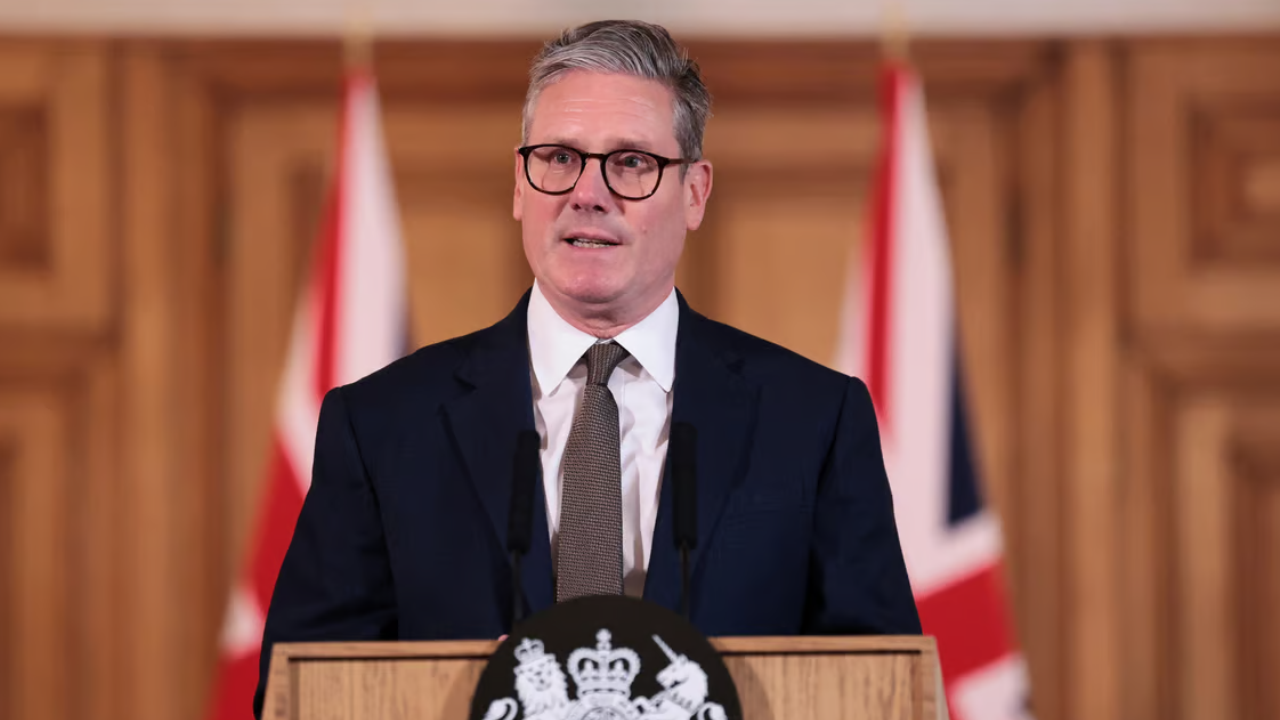

In a bold diplomatic shift, Keir Starmer, British prime minister, has announced that the United Kingdom will recognise a Palestinian state at the United Nations General Assembly in September, unless Israel undertakes a series of “substantive steps” to end the humanitarian crisis in Gaza and commit to a credible peace process.
The announcement, made during a press conference following an emergency cabinet meeting, marks a significant departure from the UK’s traditional stance and puts further international pressure on Israel amid mounting calls for a ceasefire in the Gaza Strip.
Starmer said the decision is driven by two urgent concerns: the “intolerable” humanitarian situation in Gaza and the diminishing prospects for a two-state solution.
“This is intended to further that cause,” he told reporters. “It’s done now because I’m particularly concerned that the idea of a two-state solution is reducing and feels further away today than it has for many years.”
The prime minister stressed that the UK’s ultimate goal remains a “safe and secure Israel” alongside a “viable and sovereign” Palestinian state. He added that the move to recognise Palestinian statehood is part of an eight-point peace plan the government has been quietly working on for some time.
Recognition tied to clear conditions
Under the plan outlined by prime minister keir starmer, the United Kingdom will move forward with recognising a Palestinian state in September unless Israel takes clear and substantive steps on several key fronts.
First, Israel must act to end what starmer described as the “appalling” humanitarian situation in Gaza—a crisis that has worsened dramatically in recent months, with aid access severely limited and civilian suffering escalating.
Second, the UK is demanding that Israel reach a formal ceasefire to halt the ongoing violence and provide immediate relief to those affected on both sides of the conflict.
Third, Israel must make a clear and public commitment that it will not proceed with any annexation of territory in the occupied West Bank—an issue that has long been a major obstacle to peace efforts and a red line for many in the international community.
Finally, the Israeli government is expected to commit to a genuine, long-term peace process aimed at achieving a two-state solution—one that guarantees a safe and secure Israel alongside a viable and sovereign Palestinian state.
If these conditions are not met by the time of the United Nations General Assembly in September, starmer has said the UK will formally recognise Palestinian statehood as a means of advancing peace and reasserting the urgency of a negotiated resolution.
Starmer made clear that the recognition will not be a symbolic gesture, but a strategic move to influence realities on the ground.
“There must be 500 trucks entering Gaza daily,” he said, highlighting the scale of humanitarian aid required. “Ultimately, the only way this humanitarian crisis will end is through a long-term settlement.”
Israel rejects Starmer’s plan
Israel was swift to reject the UK prime minister’s announcement. A statement from the Israeli government criticised what it described as a shift in British policy driven by internal political pressures and external diplomatic moves—particularly France’s recent stance on Palestinian recognition.
“The shift in the British government’s position at this time, following the French move and internal political pressures, constitutes a reward for Hamas and harms efforts to achieve a ceasefire in Gaza and a framework for the release of hostages,” the statement said.
Divided transatlantic response
In Washington, the reaction has been more cautious. Donald Trump, United States president currently en route from Scotland, where he met with Starmer and discussed the Middle East, declined to take a definitive position.
“I’m not going to take a position. I don’t mind him [Starmer] taking a position,” Trump said during an impromptu Q&A on Monday. “I’m looking to get people fed right now.”
His comments contrast sharply with those of the US State Department, which criticised France’s similar announcement last week as “counterproductive” and potentially emboldening Hamas.
A statement from the department read: “It reflects a pattern of counterproductive gestures that only embolden Hamas, encourage its obstruction of a ceasefire, and greatly undercut our diplomatic efforts to end the suffering in Gaza.”
Spokesperson Tammy Bruce is expected to face further questions on the administration’s position at a scheduled briefing in Washington later today.
Growing pressure within the UK
The UK government’s decision follows a groundswell of domestic political support for recognising Palestinian statehood. Just days ago, 221 MPs from nine political parties signed a joint letter urging the prime minister and foreign secretary David Lammy to act.
The letter, spearheaded by labour MP Sarah Champion, argued that recognition would lend real weight to the UK’s long-standing support for a two-state solution and help restart meaningful negotiations.
“A two-state solution remains the only viable proposal to secure a lasting peace for the region,” champion said.
Among the signatories were 131 Labour MPs, including high-profile figures such as former minister Liam Byrne and select committee chair Ruth Cadbury.
Global momentum building
Currently, around 140 countries officially recognise a Palestinian state. Last year, Spain, Ireland, and Norway formally extended recognition, arguing that doing so could pressure Israel into halting military operations in Gaza. France, while not yet taking that step, has signalled it will do so at the UN General Assembly in September—now the same deadline set by the UK.
Despite growing momentum, sceptics warn that recognition may prove largely symbolic unless deeper questions about Palestinian governance and borders are resolved. Critics argue that without clarity on who would govern a future state and what its final borders would be, recognition could deepen divisions rather than foster peace.
No equivalence with Hamas, says Starmer
Addressing criticism that the announcement could be seen as rewarding militant groups, Starmer reiterated the UK’s firm stance against Hamas.
He demanded that Hamas release all hostages, agree to a ceasefire, disarm, and accept they will play no future role in the governance of Gaza.
“There is no equivalence between Israel and Hamas,” he stated bluntly.
As the countdown to September’s UN General Assembly begins, the UK’s conditional move has reignited a complex and highly charged debate—one with implications not only for the region, but for Western unity and the future of international diplomacy in the Middle East.
BusinessDay