

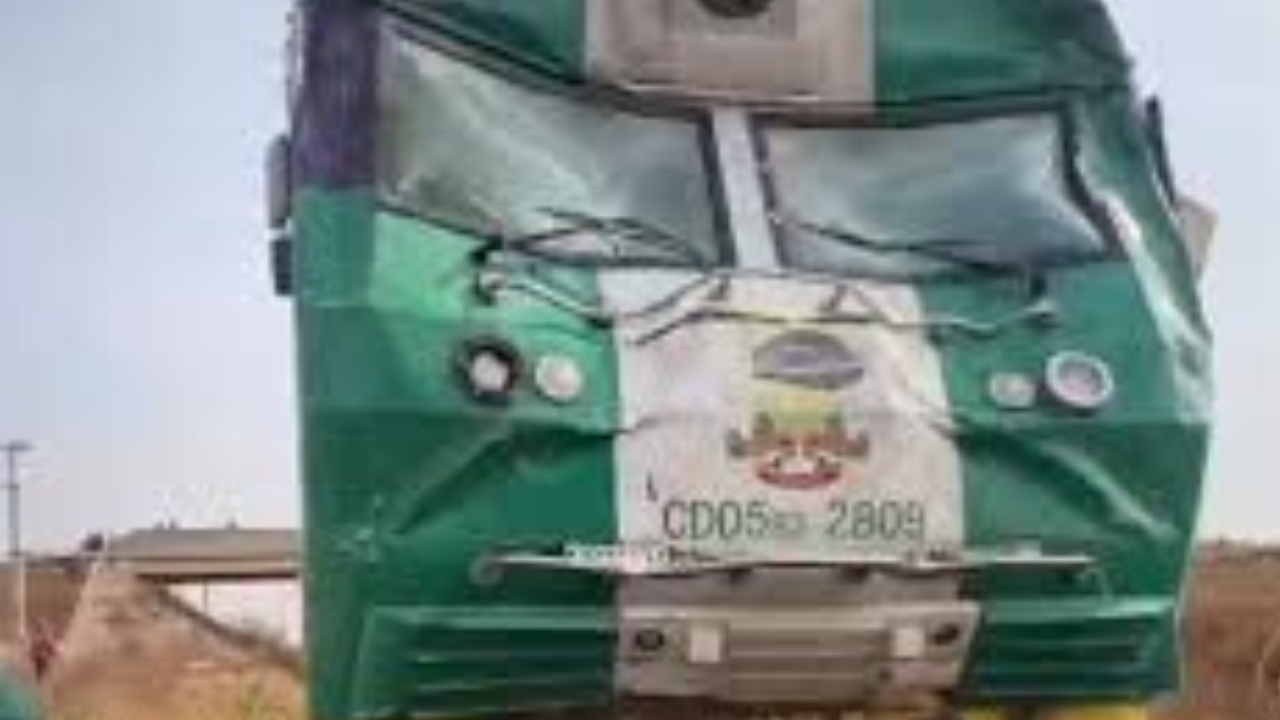

The Nigerian Railway Corporation (NEC) and the Nigerian Safety Investigation Bureau (NSIB) have confirmed that a train operating on the Kaduna-Abuja rail corridor was involved in an accident on Monday, leaving several passengers injured.
The incident occurred near the Asham section of the rail line in Kaduna State while the train was travelling from Rigasa Station in Kaduna to Idu Station in Abuja.
According to the management of the Nigerian Railway Corporation, the accident occurred at about 10:30 am and involved a rear locomotive and the passenger coach directly attached to it following a coupling failure.
While no fatality was recorded, the incident caused serious and minor injuries to passengers who were rushed to undisclosed hospitals.
Recall that in September 2025, an accident occurred along the same corridor that caused a train to somersault, resulting in varying degrees of injuries to 21 passengers.
Confirming the development in a statement, the Managing Director of the NRC, Dr Kayode Opeifa, said the injured passengers were immediately attended to and taken to a nearby medical facility for treatment.
He added that emergency protocols were activated immediately after the occurrence, with technical teams deployed to the scene to address the situation.
The NRC boss further explained that the affected train eventually arrived at Idu Station in Abuja at about 10:39 a.m., approximately 38 minutes behind schedule, after the damaged rear locomotive and coach were removed.
He stated, “The Management of the Nigerian Railway Corporation wishes to confirm that an avoidable train incident occurred at about 10:30 am today near Asham, involving a rear locomotive and a passenger coach next to it due to a coupling issue.
“Some passengers sustained injuries and were promptly attended to and taken to a nearby medical facility for proper medical care. No fatalities were recorded. The train arrived at Idu station at about 10.39 am, 38 minutes behind schedule due to the time allowed to remove the incident rear locomotive and coach Sp 0006.”
Meanwhile, the Nigerian Safety Investigation Bureau said it had commenced a full investigation into the accident to determine the circumstances that led to the incident.
The bureau, in a statement signed by its Director of Public Affairs and Family Assistance, Funke Arowojobe, explained that the train, identified as KA2, departed Rigasa Station at the start of its scheduled journey and arrived at Jere Station at 08:52 a.m. before continuing its trip toward the Federal Capital Territory.
However, shortly after leaving the station, the rear locomotive attached at Jere for operational support became detached as the train moved along a downward gradient toward the Asham section.
Investigators added that the detached locomotive then rolled forward and struck the rear portion of the train, causing the operational incident. At the time of the accident, the train consisted of two locomotives positioned at the front and rear, a power car, two business class coaches, and six standard passenger coaches.
The bureau said the service was conveying 429 passengers, with 46 crew members and 24 security personnel also on board when the incident occurred.
Commenting on the accident, the Director General of the Nigerian Safety Investigation Bureau, Alex Badeh Jr., expressed concern for the injured passengers and stressed the importance of uncovering the root causes of the occurrence.
He said, “This incident reminds us that every transport journey carries the trust and expectations of hundreds of people who rely on the system to move them safely to their destination. Our thoughts are with the passengers who sustained injuries, and we commend the swift response of Nigerian Railway Corporation personnel and emergency teams who assisted those affected.”
He emphasised that the bureau would carefully examine all factors surrounding the accident to improve rail safety. “At the Bureau, we approach every investigation with a deep sense of responsibility because behind every occurrence are real people, real families, and real consequences.
“Our team will carefully examine every relevant factor to understand what happened and to ensure that the lessons from this occurrence lead to safer railway operations across Nigeria.”
The bureau said its investigators had begun evidence gathering and analysis, focusing on technical, operational, and infrastructure factors, including locomotive attachment systems, train configuration, and operational procedures.
The PUNCH