

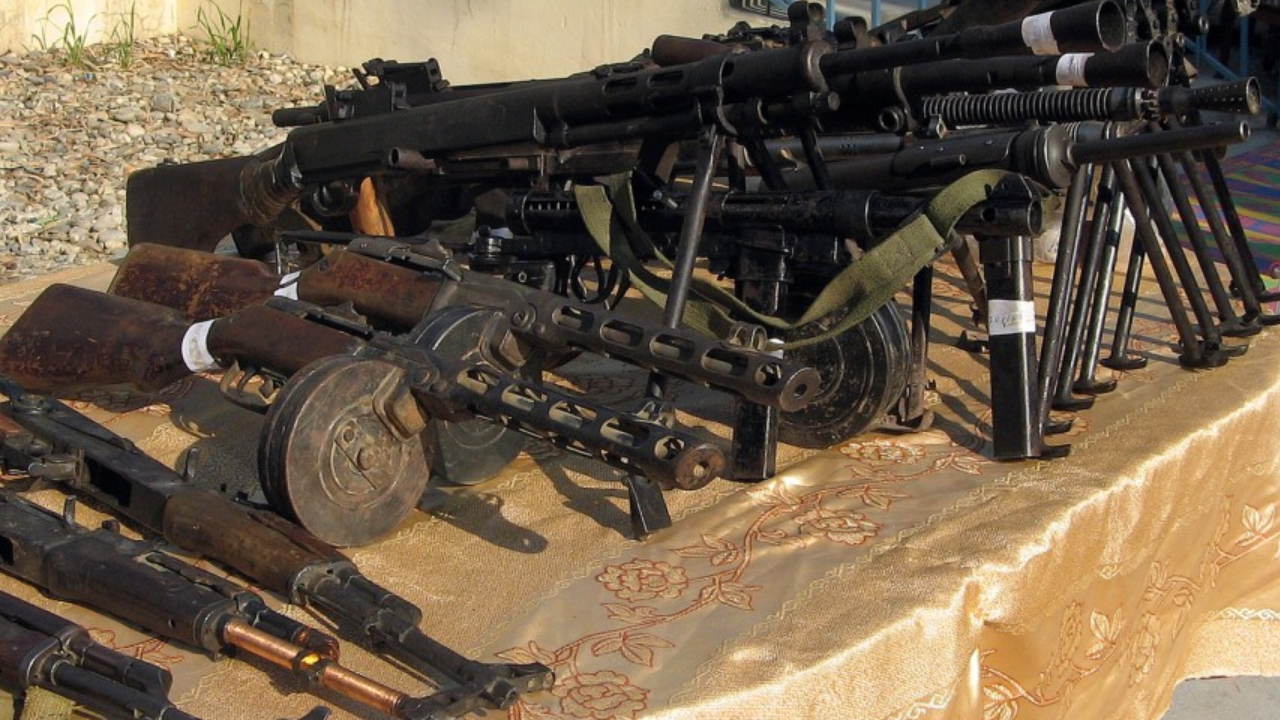

Nigeria and other African countries may face heightened security risks due to limited access to modern weapons, as new data shows the continent accounts for a small fraction of global arms imports.
Figures released by Stockholm International Peace Research Institute indicate that Africa contributed just 4.5 per cent of global arms imports in 2024 and 2025, compared to Europe’s dominant 48.2 per cent.
The data, published in March 2026, tracks the volume of international transfers of major weapons systems—including sales, military aid and licensed production—rather than their financial value.
Security analysts warn that the disparity could weaken the capacity of African nations to respond effectively to growing threats, including terrorism, insurgency, and transnational crimes
Across the African continent, total arms imports stood at 3.095bn in volume terms. Egypt emerged as the largest importer, recording a combined total of 825 million (1.3 per cent), followed by Morocco with 522 million (0.8 per cent) and Algeria with 313 million (0.5 per cent).
Other notable importers included Ethiopia (111 million), Sudan (107 million) and Nigeria, which recorded a total of 114 million, representing 0.2 per cent of global imports within the period under review. Nigeria’s import dropped from 93million arms in 2024 to 21 million in 2025.
Angola, Kenya and Mauritania also posted moderate figures, each contributing about 0.2 per cent.
In contrast, Europe dominated the African continent in the global arms flows, with a combined total of 30,916 million in import volume, accounting for 48.2 per cent of global transfers.
Ukraine topped the global chart with 7.605bn, representing 12 per cent of total imports, reflecting the ongoing impact of the war with Russia and sustained military support from Western allies.
Poland followed with 3.711bn (5.8 per cent), while Germany recorded 1.872bn (2.9 per cent).
The United States ranked fourth with 1.798bn (2.8 per cent), alongside other major importers such as Greece (1.205bn), the Netherlands (1.157bn), and the United Kingdom (1.095 bn).
Other European countries, including Italy, Hungary, Belgium and Norway, each accounted for between 1.2 and 1.7 per cent of global imports, further highlighting the region’s significant share of international arms transfers.
On the supply side, the United States remained the world’s leading arms exporter, with 28bn billion in transfers, accounting for 43 per cent of global exports. France followed with 5.8bn (9.1 per cent), while Russia recorded 4bn (6.1 per cent).
Group maps solution to herders-farmers feud
Germany and Israel also featured prominently among top exporters, posting 3.8bn (5.9 per cent) and 3.8 bn (5.9 per cent), respectively.
Reacting, a retired Assistant Inspector-General of Police, Wilson Inalegwu, described the situation as an opportunity for Nigeria and other African countries to become self-reliant in weapons production and security infrastructure.
“It is very important that this is happening. Our government agencies should learn from it. We can repatriate our weapons; it is an opportunity for us to be self-sufficient,” he said.
Inalegwu warned that overdependence on foreign sources for military hardware could expose the country to future risks.
“If this continues, it means we can just be cut off one day. So, let us look inward, develop our steel sector, and invest in science and technology. That is what will give us the edge,” he added.
He further stressed the importance of innovation over sheer force in modern warfare.
“Strength lies in creativity, not just brute force. Even smaller countries are gaining advantages through innovation. When your neighbour deprives you of food, he is teaching you how to farm. It is a big lesson. Every challenge is an opportunity for growth,” Inalegwu stated.
The PUNCH