

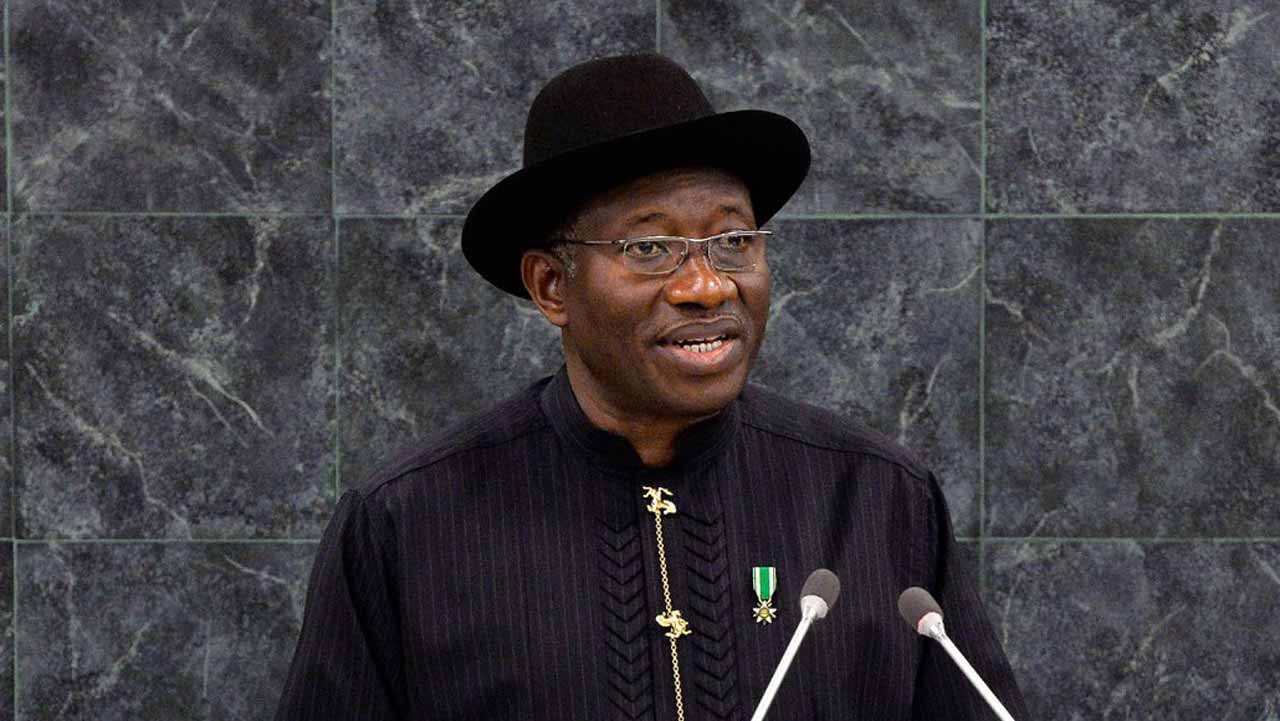

Ex-President Goodluck Jonathan has urged the National Assembly to review Nigeria’s electoral litigation framework and establish a Constitutional Court to handle election-related disputes.
Jonathan made the call in Abuja on Wednesday during the 70th birthday celebration and book launch of former Ogun State Governor, Gbenga Daniel.
He argued that creating a specialised court would streamline the resolution of electoral cases and reduce the burden on the country’s political and judicial systems by limiting such disputes to a single phase.
The former president criticised the current three-tier litigation process for governorship elections, which moves from election tribunals to the Court of Appeal and ultimately the Supreme Court, describing it as ineffective and prolonged.
Reflecting on Nigeria’s electoral history, Jonathan recalled a 2011 case in which a governorship candidate lost an election due to a technicality involving the colour of ink used by voters.
“I remember a particular case where someone lost an election as a governor because the law then stipulated the use of red ink to tick voters’ names.
“In an entire senatorial district, they were not provided with red pens and used available black or green pens.
“As a result, those votes were cancelled. The Appeal Court upheld this, even though the lower tribunal felt that a tick is a tick,” he said.
Jonathan explained that although the National Assembly later amended the law to allow governorship election cases to reach the Supreme Court—aimed at preventing such injustices—it failed to address the issue of lengthy litigation.
He suggested that Nigeria adopt a system similar to that of Francophone African countries, where Constitutional Courts exclusively handle political and electoral matters.
“If the Supreme Court continues to be the terminal court for governor’s elections, then they don’t need to go through the lower tribunal, so that it would just be one step.
“I believe the ideal thing to do, which I was considering when I was in office, was to make sure that it’s only one tribunal that listens to any litigation relating to politics.
“This is done, especially in the Francophone countries in Africa. They have constitutional courts, anything about elections, only the constitutional courts that take decisions,’’ he said.
Jonathan also charged the judiciary to remain firm and decisive in order to sanitise the nation’s political system.
“Politics is like soccer, and the judges are the referees. If the referee looks the other way, players will break legs or score with their hands,” he added.
Speaking on the celebrant, Jonathan described Daniel as a “constructive leader” who brought an engineering mindset into politics, which he referred to as “murky waters.”
He recounted how Daniel was selected as the South-West Zonal Coordinator for his 2015 presidential campaign due to his credibility and ability to work across political divides.
“I can attest to the fact that he is a man who really thinks like an engineer—very constructive and dedicated,” Jonathan said.
He also commended Daniel for documenting his life experiences in books, noting that such efforts help correct public misconceptions.
“I always appreciate people who put on paper their experiences and what happens to them. I pray and hope that I will do it one day so that younger people will read about Goodluck Jonathan.
“There are a lot of stories about me. Maybe 50 per cent of them, whenever I read, they are not correct. But people say whatever they want to say.
“So it’s only when the author himself, when the actor documents it, then people say, oh, this is what happened,’’ Jonathan said.
The event was attended by Bola Tinubu, who was represented by the Minister of Finance and Coordinating Minister of the Economy, Wale Edun, as well as former President Olusegun Obasanjo, traditional rulers, and other political stakeholders.
The PUNCH