

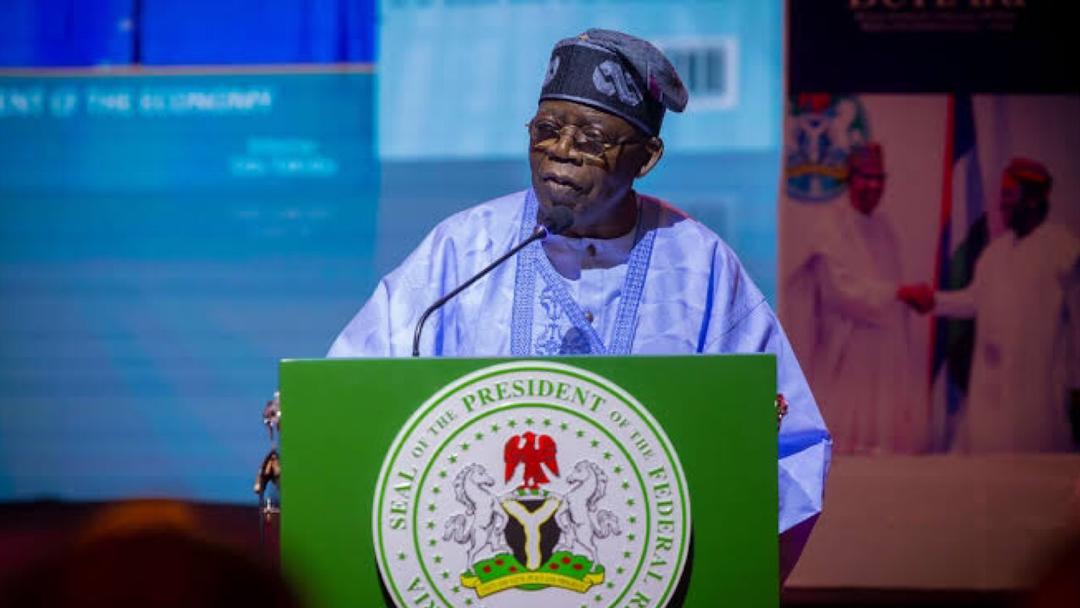

President Bola Tinubu has said that colonial-era tax laws contributed to economic hardship in Nigeria, arguing that fragmentation, multiplicity and inconsistencies in the old fiscal framework weakened national prosperity.
This was disclosed in a statement titled,” Old tax laws made Nigerians poor, new systems will create opportunities and prosperity, says President Tinubu”, signed by Bayo Onanuga, Special Adviser to the President on Information and Strategy on Tuesday.
Tinubu made the remarks during the commissioning of the 16-storey Nigeria Revenue Service Headquarters in Abuja, an event attended by Senate President Godswill Akpabio, Speaker of the House of Representatives Tajudeen Abbas, ministers, lawmakers, governors and private sector leaders.
He said the new tax reforms introduced by his administration are designed to create a more inclusive, investment-friendly and people-centred system that will drive long-term economic growth.
According to the President, the new tax system, which became fully operational in January, was introduced to replace outdated colonial structures and strengthen Nigeria’s fiscal foundation.
“On my inauguration day, I made a solemn pledge that we will move Nigerians from the dimness of uncertainty into the clear light of renewed hope. I committed to confronting structural weaknesses, restoring financial stability, and building an economy anchored in discipline, equity, and opportunity.
“Today, I stand before you to reaffirm that these words were not rhetoric; they were a covenant with the Nigerian people,” Tinubu said.
He described the new reforms as a deliberate effort to build a transparent and efficient revenue system capable of supporting national development and restoring public trust in government institutions.
The President commended the Executive Chairman of the NRS, Dr Zacch Adedeji, for delivering the new headquarters within 30 months, noting that the building would house about 3,000 staff alongside modern facilities including a data processing centre, clinic, auditorium, training rooms, a gym and a library.
“We are not gathered here merely to commission an edifice. We are here to mark a milestone in a larger national journey: the deliberate strengthening of our fiscal foundation and rebuilding of confidence in public institutions,” he said.
Tinubu added that no nation can achieve sustainable prosperity with a weak or fragmented revenue system, stressing that his administration chose “far-reaching tax and fiscal reforms” to correct long-standing inefficiencies.
He also praised the Minister of State for Finance, Taiwo Oyedele, for his role in modernising the tax framework.
Addressing concerns about the reforms, Tinubu said the system was designed to simplify taxation, eliminate distortions, and promote fairness while protecting vulnerable Nigerians.
“The reforms are designed to simplify our system, eliminate distortions and create a fair, transparent and investment-friendly environment. Our direction is clear: to have a revenue system that rewards enterprise, supports growth, and ensures that every contribution to the national cause is matched by feasible value for the people,” he said.
He added that early results from the reforms were already visible in improved fiscal stability, stronger foreign reserves and increased investor confidence.
In his remarks, Senate President Akpabio urged Nigerians to be patient with the administration, saying economic reforms were beginning to yield positive outcomes, particularly in fuel supply stability.
Speaker Tajudeen Abbas also praised the reforms, noting that Nigeria’s previous tax system suffered from fragmentation and overlapping mandates that reduced efficiency.
Executive Chairman of the NRS, Zacch Adedeji, described the reforms as one of the most significant in Nigeria’s fiscal history, noting that over 60 tax laws had been streamlined into a single framework.
He said revenue collection had grown significantly in recent years, adding that improved fiscal governance had strengthened transparency and public finance management.
The new NRS headquarters was constructed by China Civil Engineering and Construction Company, whose Managing Director, Guan Shuai, praised Tinubu’s leadership and economic reforms.
The PUNCH