

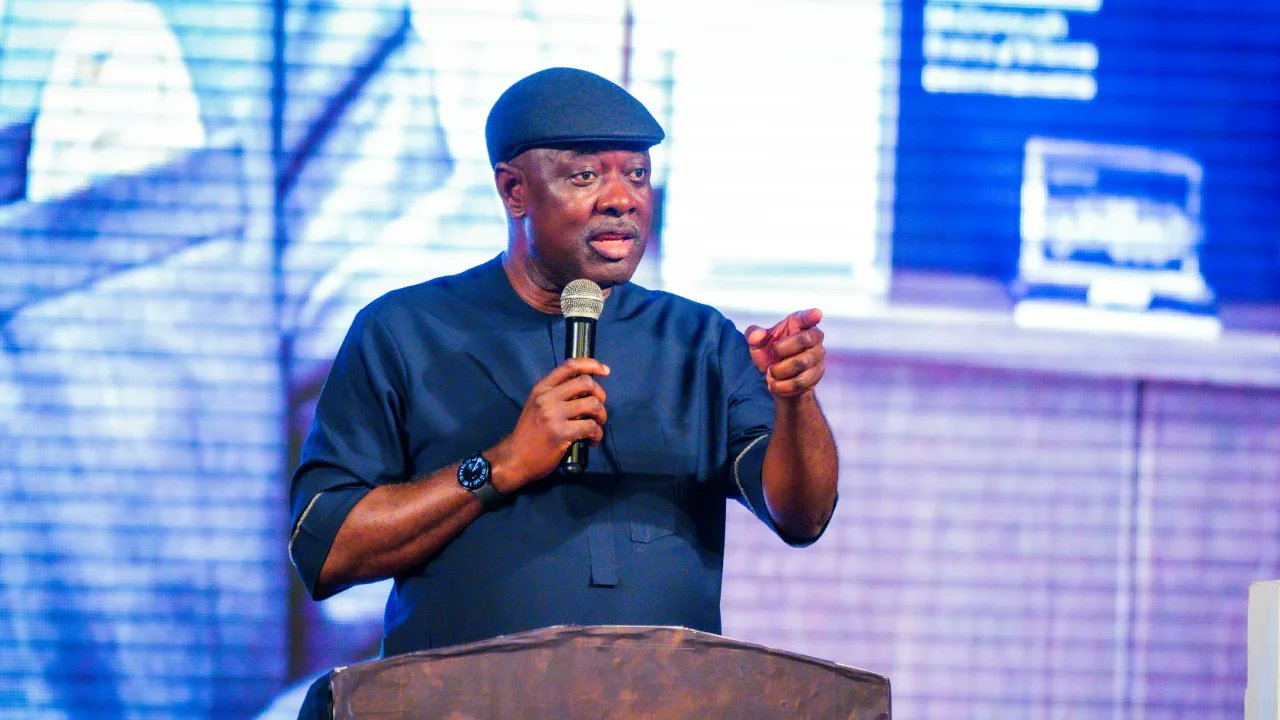

Mounting pressure on domestic energy costs has drawn a defence of downstream deregulation from the Minister of State for Petroleum Resources (Oil), Heineken Lokpobiri, who maintains that average petrol prices in Nigeria remain below those recorded in the United States and several neighbouring African nations.
Appearing on Channels Television’s Politics Today on Tuesday, the minister maintained that high energy costs represent an international burden rather than a purely national issue.
“Oil and gas is a global commodity. What is sold in New York is what is also sold here. So, no matter what you may think, America, or Saudi Arabia, or anywhere in the world, energy prices will always be the same,” he noted.
His remarks coincide with recent price cuts across major domestic depots, including the Dangote Petroleum Refinery, which lowered its ex-depot price from ₦1,350 to ₦1,325 per litre following a decline in global crude oil prices. Similar reductions were recorded across key distribution hubs in Lagos, Port Harcourt, Calabar, and Warri, though pump prices at various retail outlets still range between ₦1,370 and ₦1,450 per litre.
Despite local refining capacity, Lokpobiri cautioned against the assumption that domestic oil production or the operational presence of the Dangote Refinery would guarantee lower pump prices, pointing to global market dynamics that affect even top energy producers.
“As at today, the records available show that USA is the highest producer of oil and gas in the world. The United States is the highest producer of oil and gas in the entire world. They also have the highest refining capacity, but the fuel price per liter is higher than that of Nigeria.
“So despite the fact that Dangote Refinery is here, that doesn’t mean that the fuel price will be lower because Dangote Refinery is available. But what is important is that the regulation has also created a new economy,” he added.
The minister argued that local prices remain relatively moderate, highlighting comparative international rates.
“In the US, the average, you know, liter of fuel is N1,633. In Nigeria, it’s on the average of N1,430. If you go to Cameroon, it’s N1,959. If you go to Ghana, it’s N2,070. If you go to South Africa, it’s N2,070. So Nigeria’s average cost of fuel per litre is still lower than,” he said.
According to Lokpobiri, ending petrol subsidies has provided vital fiscal relief by channelling substantial savings directly to the three tiers of government through the Federation Account Allocation Committee.
“These days we get 2.1 trillion being shared. This is the first time it is happening. You’ll recall that before this government came, about 27 states had no capacity to pay even salaries. Today, states are doing gigantic projects. It’s because of the savings that we made from this subsidy,” he stated.
The minister argued that ending government fuel imports and price suppression was essential to attracting private sector capital into midstream and downstream infrastructure.
“But for the policy of deregulation, Dangote Refinery wouldn’t have been the most attractive IPO in the continent. If government was continuously importing, as NNPC was doing, and selling at a lower price than the market price, Dangote wouldn’t have been able to survive,” he explained.
He added that market reform aims primarily to allow commercial ventures to flourish across the broader oil and gas ecosystem.
“Deregulation all over the world is to enable private sector businesses to thrive and all the businesses that are associated with with the oil and gas sector,” Lokpobiri stated.
The minister confirmed that the government will not roll back deregulation, citing rising foreign reserves and aviation fuel production as signs of progress. He added that recent figures from the Central Bank of Nigeria show that the oil and gas sector accounts for 85 per cent of the nation’s foreign exchange reserves.