

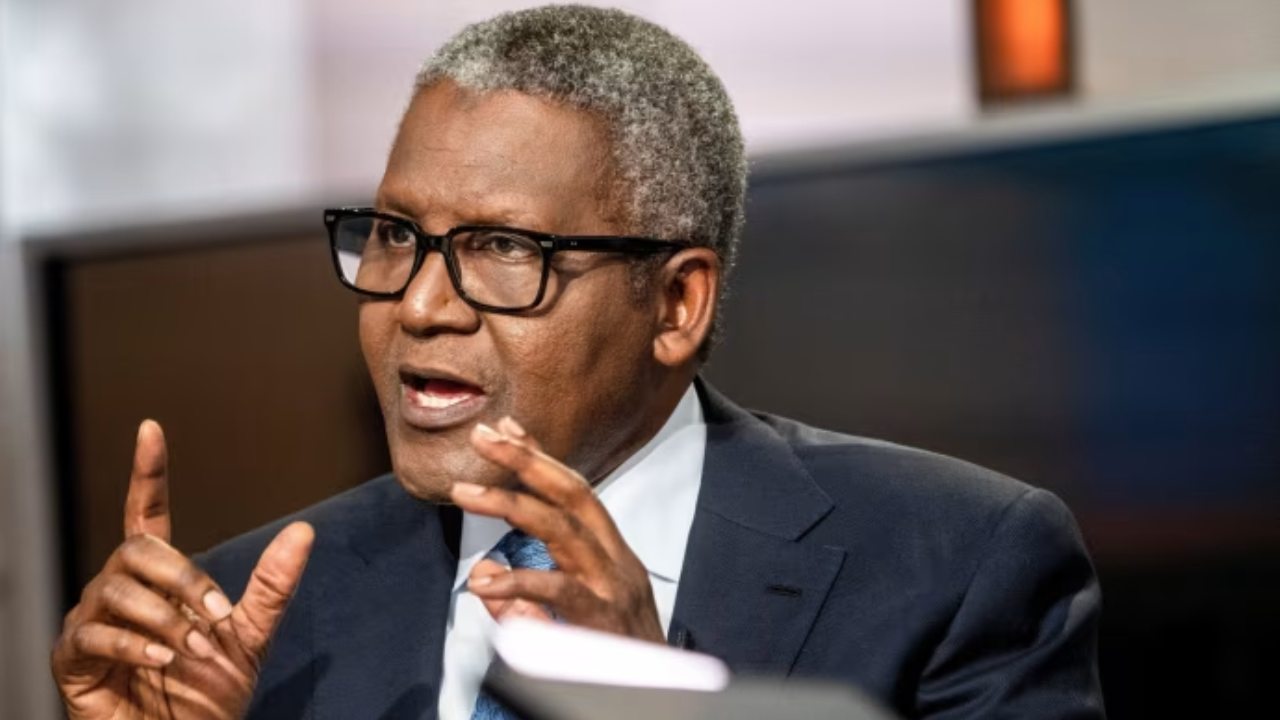

Industrialist Aliko Dangote has declared his readiness to navigate legal hurdles across the continent while expressing a willingness to dilute his stake in the Dangote Petroleum Refinery down to 25 per cent as more Africans buy shares.
Speaking during a fireside chat at the Nairobi Securities Exchange, Africa’s wealthiest individual outlined his group’s strategy to democratise wealth creation by offering more equity to retail investors across Africa.
Dangote revealed that initial plans to raise $2.5 billion (₦3.3 trillion) through private placements and an initial public offering saw private placement demand surge to $3.7 billion. The conglomerate subsequently launched an additional $1.6 billion offering to broaden access, with Dangote signalling an appetite to list the facility directly on the Nairobi exchange rather than in Nigeria.
“This $1.6bn that we have, I can tell you for nothing that we will sell more. We will go to the regulator and ask the regulator that, ‘Look, there is more demand; we want more Africans to own it ‘. As we go along, we don’t mind, even if Dangote will end up having twenty or twenty-five per cent, we have nothing to hide,” Dangote stated, emphasising that shareholders could vote out leadership if dissatisfied with performance.
The announcement coincides with a fresh legal challenge in Kenya, where the Malindi Environment and Land Court ordered the preservation of status quo on land designated for a proposed 700,000-barrel-per-day refinery in Lamu County. The lawsuit, brought by 133 local residents claiming ancestral land rights, requires both parties to halt on-site activities pending an October 14 hearing.
Despite the legal block, the Dangote Group confirmed the court order would not prevent the scheduled groundbreaking ceremony from proceeding, clarifying that site operations might experience temporary adjustments.
Dangote struck a defiant tone regarding regulatory and judicial disputes, describing them as routine operational hurdles in African markets. Reflecting on past expansion obstacles, he cited a major dispute in Senegal where operations were suspended for an entire year before being resolved at the Supreme Court.
“In Senegal, it’s not even the court. They stopped our factory for one year. We went up to the Supreme Court to get a judgement. So anybody who wants to cause trouble, we are ready for them,” Dangote said. He added: “I’m sure some of you must have seen that one court has given an order that we shouldn’t do any construction? I said no, no. This is normal for us in Africa. In fact, this is even small”.
The ambitious Lamu complex, which was budgeted between $15 billion and $16 billion (₦19.9 trillion to ₦21.2 trillion) with a target completion date of 2030, is designed to mirror the group’s flagship mega-refinery in Nigeria. Construction equipment has already been deployed to the location.
Dangote affirmed his commitment to regional integration, stating, “We’re taking Kenya as our home. It is home here, and that’s why we’re here to invest. Anywhere in Africa is home, because we understand the issues, we understand the problems”. He noted that the mega-project would create substantial economic spillover effects, requiring over 60,000 workers during its construction phase while driving industrial growth for local small and medium-sized enterprises.