

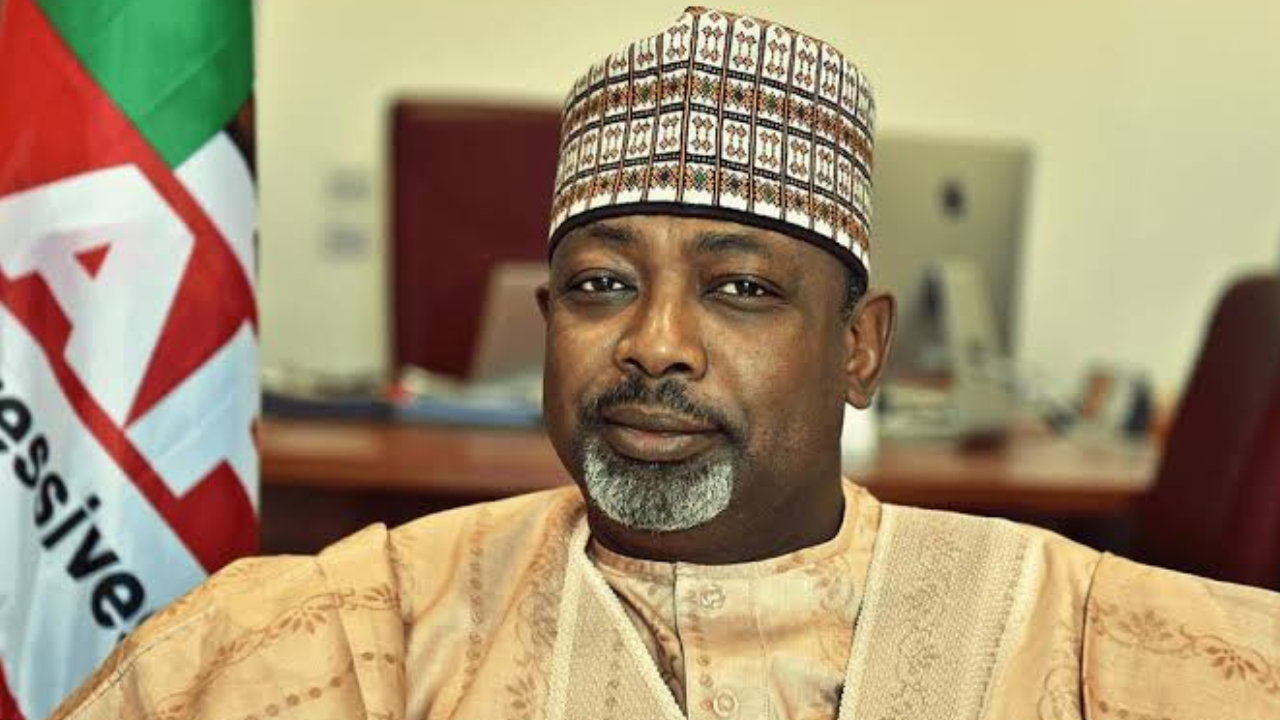

Agricultural output across Nigeria has expanded under the current administration, but persistent bottlenecks in processing and supply chains continue to prevent food prices from dropping significantly for consumers.
Speaking in an interview on ARISE NEWS on Friday, Minister of Agriculture and Food Security Abubakar Kyari explained that while government reforms have pushed farm-gate costs down, gaps between rural producers and urban markets remain an obstacle.
He noted: “Let’s go down memory lane and think about the figures in 2023 and 2024. When you look at those and compare them with what the reforms of President Bola Ahmed Tinubu’s administration have done, we are on the right track.”
According to Mr Kyari, official figures confirm that agricultural production costs have decreased considerably, even though agro-processing charges have failed to follow suit.
“However, even if you look at the NBS figures, you would see that agro-processing has not come down, but production has come down. Which means at the farm gate, prices have come down considerably,” the minister said. “So, these are other gaps that need to be looked at. But we have tackled the production of food, and we have seen considerable success in that regard.”
While addressing the nation’s reliance on foreign produce, Mr Kyari pointed to rapid population growth, averaging between eight million and nine million people annually, alongside low baseline productivity, land access constraints, and high input expenses as key drivers of import dependence. He explained that due to certain factors, the nation had not been able to catch up in terms of population growth, noting: “25 years ago, we were half of what we are today, and 25 years from now, we will be double what we are.”
To counter this, the government has provided subsidised seeds and inputs to enhance crop yields, whilst seeking to curb processed food imports through farm mechanisation, local value addition, and the development of Special Agro-Processing Zones (SAPZs).
“That’s exactly what the government is trying to do. If you recall the ban on the export of raw items like shea nuts, and so also we’re looking at other areas and crops that we can reduce so that we add value,” Mr Kyari said, adding that eight SAPZ hubs covering production, storage, processing, and marketing will become operational before the end of next year, with a second phase expanding into ten additional states.
Security improvements have further aided recovery, allowing farmers to return to previously inaccessible areas and driving successive harvest expansions in 2024 and 2025. Official 2026 rain-fed harvest data, compiled alongside the National Agricultural Extension Research Liaison Services at Ahmadu Bello University, Zaria, is expected between October and November, with future reports scheduled to cover year-round farming cycles.
The minister anticipated that the 2026 harvest will surpass the previous year’s yield, supported by input stabilisation and interventions from bodies such as the Bank of Agriculture and the National Agricultural Development Fund, which supplied free fertilizer to farmers alongside a 50 per cent input subsidy.
On agricultural technology, tractors distributed under the national mechanisation policy are currently deployed nationwide. The ministry is actively monitoring equipment usage to ensure each unit clears between 500 and 600 hectares annually.
“So even if you have a farm that is about 100 hectares, you must pass on those subsidies that you have to your neighbors so that a tractor is being tracked to do at least 500 to 600 hectares annually,” the minister said. “That is productivity. So when we have 2,000 tractors, it means we’re looking at a million hectares easily for every year for land preparation.”