

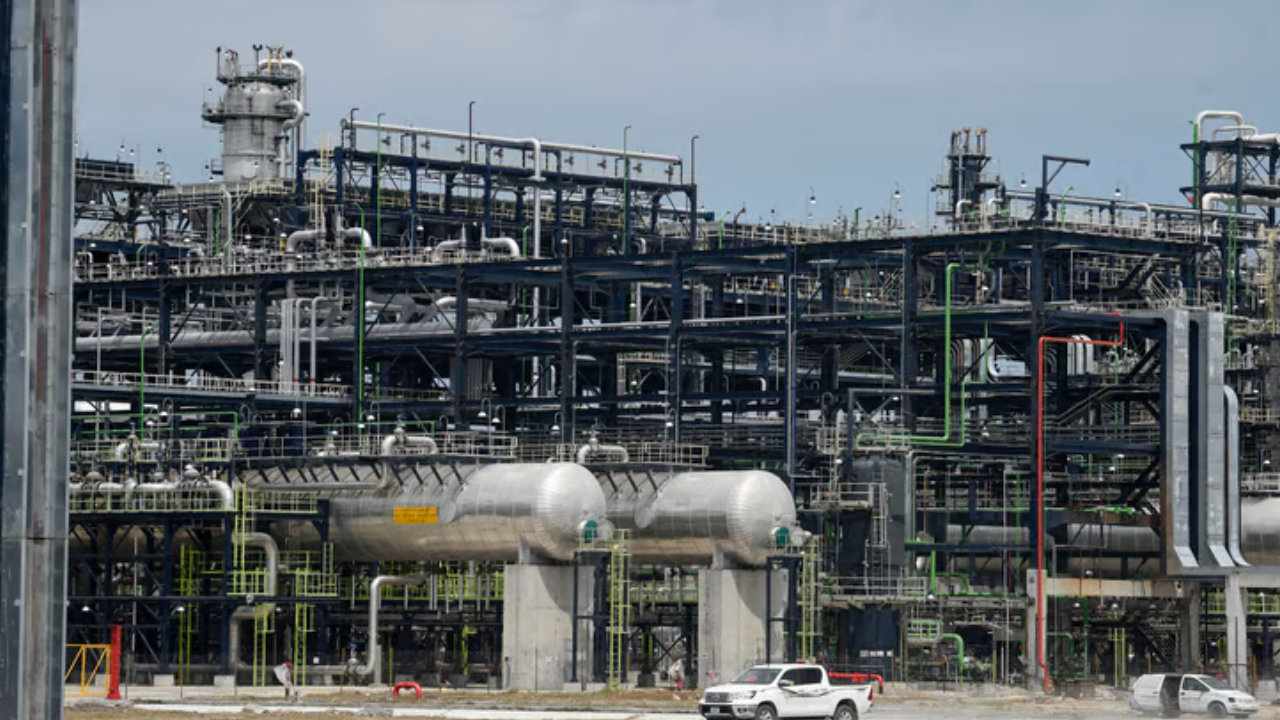

Marketers of petroleum products have stated that the loading of fuel has been put on hold at the Dangote Petroleum Refinery following the facility’s decision to sell fuel in dollars.
Many marketers said on Sunday that the facility was not even loading its trucks, sparking fear of possible fuel tightness across the country. But the refinery denied the claim, arguing that fuel loading was ongoing within the Lekki-based plant.
The National Publicity Secretary of the Independent Petroleum Marketers Association of Nigeria, Chinedu Ukadike, in a telephone interview on Sunday, said marketers were being forced to adopt a cautious approach because of the uncertainty surrounding the next price of petrol.
“The issue is simple; marketers are not buying because they are trying to look at the market dynamics. Whatever we are using today is existing products in tank farms, which we are buying around N1,250 and N1,300,” Ukadike said.
He said the uncertainty had been worsened by the expected arrival of new crude supplies and imported petrol, whose pricing templates remained unclear.
“The problem we are now facing is that this new crude oil that they are bringing what will be the template? Also, those who have brought in petroleum products and are given licences are also estimated to place their price at N1,350, which marketers are also wary of,” he stated.
Ukadike said marketers were therefore reluctant to load large volumes because they could not predict whether the price of petrol would rise or fall after they had purchased the product.
“So everyone is just sceptical about loading products because when you load, you don’t know the next price, if it is going to reduce or go higher. You are still expected by consumers to sell at the prevailing price,” he said.
According to him, the uncertainty has not completely halted the distribution of petrol, but has significantly reduced the volume being loaded by marketers.
He urged the Federal Government to intervene and resolve the dispute over the pricing template, warning that continued uncertainty could further disrupt the downstream market. “The Federal Government has to look inward and resolve this issue once and for all. This template issue should be resolved immediately,” Ukadike said.
The National Publicity Secretary of the Independent Petroleum Marketers Association of Nigeria (IPMAN), Chinedu Ukadike, in a telephone interview on Sunday, said marketers were being forced to adopt a cautious approach because of the uncertainty surrounding the next price of petrol.
“The issue is simple; marketers are not buying because they are trying to look at the market dynamics. Whatever we are using today is existing products in tank farms, which we are buying around N1,250 and N1,300,” Ukadike said.
He said the uncertainty had been worsened by the expected arrival of new crude supplies and imported petrol, whose pricing templates remained unclear.
In a report by NAN, marketers in the South-West confirmed that the uncertainty over petrol prices has forced many to halt fresh purchases, leading to the temporary closure of some filling stations.
The Zonal Chairman of IPMAN, Western Zone, Oyewole Akanni, disclosed this in an interview with the News Agency of Nigeria on Sunday in Ibadan. Akanni said the situation was triggered by the suspension of loading of Premium Motor Spirit at the Dangote refinery about four days ago.
He said the development had forced marketers to source products from private depots at significantly higher prices. According to him, the cheapest ex-depot price at private depots in Lagos currently ranges between ₦1,200 and ₦1,220 per litre, excluding transportation costs.
He added that marketers who bought products on Friday paid between ₦1,210 and ₦1,220 per litre. “The non-availability of fuel at some filling stations and the closure of others are due to fluctuations in the price of lifting fuel from depots.
“Since the Dangote refinery stopped selling PMS about four days ago, private depot owners have increased their prices. Many filling stations that have exhausted their stock are waiting to see whether prices will come down when the Dangote refinery resumes sales or increase further. Only a few marketers are buying products for now because of the uncertainty,” he said.
Akanni, however, maintained that there was no fuel scarcity, urging motorists and other consumers not to engage in panic buying. “There is no fuel scarcity. Members of the public should not panic. Although there is a possibility of an increase in the pump price if the current situation persists,” he said.
The zonal chairman said the Dangote refinery neither gave prior notice nor explained the reason for the suspension of PMS sales to marketers. Akanni said four truckloads of petrol meant for his filling stations had remained at the refinery since the suspension of loading.
“I was supposed to have received four truckloads of PMS four days ago, but that has not happened because the trucks are at the Dangote refinery, which has not been selling. The company is not even loading its own trucks. They are all parked there,” he said.
Official denies claim
However, a spokesman for the Dangote Group dismissed the report as “fake news”, accusing some marketers of spreading false information. The spokesman said that the refinery had not stopped loading petroleum products.
“The refinery is loading. Anybody can go there to check. That’s fake news to say we are not loading,” the official, who pleaded not to have his name in print due to the sensitive nature of the matter, stated.
He noted that marketers importing petrol were finding it difficult to compete because prices in Lomé, Togo, had risen, making it increasingly difficult to match Dangote’s prices.
FG vs Dangote
The Federal Government and the Dangote Petroleum Refinery have yet to reach an agreement on the issues that prompted the refinery to adopt a dollar-based pricing template, a development that could prolong uncertainty in the downstream petroleum sector and lead to a further increase in the price of Premium Motor Spirit, also known as petrol.
A senior government official involved in the ongoing discussions revealed this on Sunday. The ongoing standoff is caused by the Dangote Petroleum Refinery grievance on the continued issuance of import licences to marketers and a row on the modalities of crude oil supply.
The official, who spoke on condition of anonymity because of the sensitivity of the negotiations, said the dispute had gone beyond the price of petrol, stressing that it was also linked to the volume of crude supplied to the refinery and the proportion of crude sold to it in naira.
According to the official, the refinery has been unhappy with the Federal Government over the continued issuance of import licences to some oil marketers despite its ability to refine large volumes of petrol for the domestic market.
The official said Dangote was also dissatisfied with the volume of crude supplied to the refinery by the Nigerian National Petroleum Company Limited, as well as the relatively small proportion of the crude purchased in naira.
“So the issue is that Dangote is unhappy about two things; one is that the government gave import permits. They issued import permits to some companies while his refinery is capable. So he was already angry on that level.
“Then number two is that the refinery is saying that it is not getting enough crude oil even from the Nigerian National Petroleum Company Limited. The percentage of naira for crude that they are giving to the facility is not a lot.
“Number one is that the facility is still not getting enough, according to him. And number two is that the portion they are selling to him in naira is still a little. So he still has to do most purchases in dollars. So the facility is saying that if the government cannot increase the crude they are giving to him in naira, the new dollar pricing template is what he will do. So those are the two issues.”
This movement has raised fresh concerns over the stability of petrol prices, with the refinery’s decision to price its products in dollars potentially exposing domestic fuel prices to movements in the foreign exchange market.
Already, this uncertainty over petrol prices has forced many marketers to halt fresh purchases, leading to the temporary closure of some filling stations, according to the Independent Petroleum Marketers Association of Nigeria.
The official said the Federal Government had continued to engage the refinery’s management in a bid to prevent the dispute from escalating. He, however, warned that the government could not allow any single player to hold the country to ransom by demanding restrictions on imports while the parties continued to disagree over crude supply and pricing.
“The government has been discussing this matter. He said he was going to do this (dollar sale of fuel). He said this two weeks ago. And the government was asking for patience. Let us keep engaging now. So now that the new dollar pricing template has been done, the government will still keep engaging,” the official said.
The official also argued that the Dangote refinery’s location within a free trade zone gave it considerable flexibility in determining how it conducted its commercial operations, including the currency in which it sold its products.
“Unfortunately, the facility is in a free trade zone, so the refinery is actually allowed to sell in any currency it wants to sell. The refinery is in a free trade zone. And there are so many taxes not paid,” he said.
“Yes, the refinery still pays, but there are a lot of taxes the refinery is excluded from, because it is in a free trade zone. Those are the benefits you get when you are in a free trade zone.”
The PUNCH