

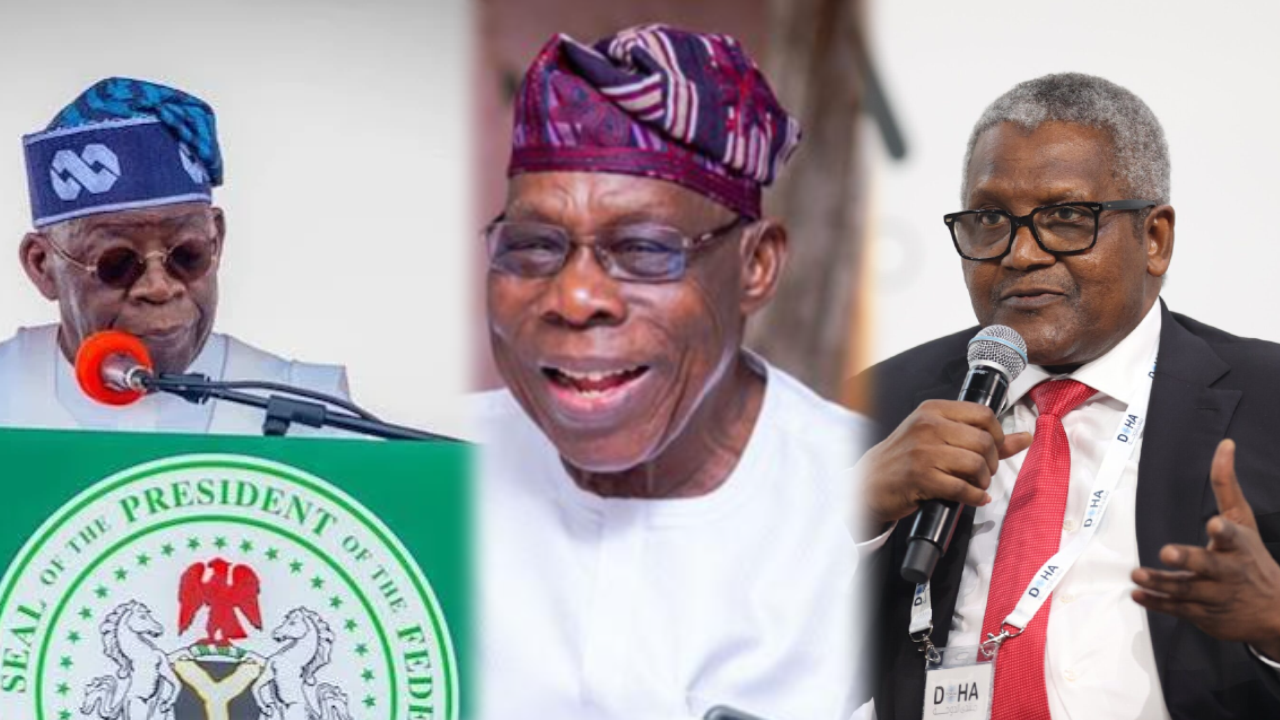

A sharp rift has emerged over the fate of Nigeria’s state-owned refineries, with President Bola Tinubu expressing firm optimism in their resurrection, former President Olusegun Obasanjo insisting public ownership will cause them to fail, and industrialist Aliko Dangote pointing to deep-seated technical obsolescence as a major barrier.
The disagreement stems from Tinubu’s stance that state-run plants in Port Harcourt, Warri, and Kaduna can be revived. Receiving the Nigeria Union of Petroleum and Natural Gas Workers (NUPENG) executive president, Salimon Oladiti, at the Presidential Villa in Abuja, Tinubu affirmed:
“The refineries you mentioned are going to come back to work. We’re just building a very firm research and structural reworking of the economy of it. Ordinary flame and smoke of a refinery doesn’t mean it’s working, until it’s profitable and yields the value for which it is built.”
Accepting full accountability for the assets and liabilities of previous administrations, Tinubu declared:
“I am not a man who looks back because I have accepted the asset and liability of my predecessor, no matter what has happened in the years past. It is my responsibility now to fix it and make it work for the largest common value of our population. I take responsibility for that, and I’m going to do it.”
His position directly counters Obasanjo’s long-held assertion that public management through the Nigerian National Petroleum Company Limited (NNPCL) is fundamentally flawed. In an interview on Sony Irabor Live, Obasanjo argued that public-private partnerships (PPP) offer the only viable route:
“One of the lessons that I learnt is that PPP works. Look, one project that has not been destroyed by the government in Nigeria is the NLNG, where the private sector has 51 per cent, and the Nigerian government has 49 per cent. See what we did with Nigerian railways.
“See what we did with the national shipping company. See what we are doing now even with the NNPC. The NNPC has refineries, and I said to people that it will never work. And a man had the audacity to say, ‘Am I a chemical engineer?’”
Obasanjo recounted his presidential tenure from 1999 to 2007, when he unsuccessfully attempted to hand over management to Shell. He noted:
“When I was there, I called Shell. I said, ‘Look, please, I beg you, come and take 10 per cent equity and run the refinery for us.’ They said no. I said, ‘Okay, if you don’t want to take equity, don’t take equity. Come and run the refineries’. They said no.”
When pressed on their refusal, Shell executives cited low downstream profitability, corruption, poor maintenance, and small plant capacities compared to global standards. Obasanjo detailed:
“He said our refineries are too small. This was when I was an elected president. He said our refineries are too small. One is 60,000 barrels and another 100,000 barrels. He said refineries at that time were in the range of 250,000 barrels to 300,000 barrels.
“He also said our refineries are not well maintained. We call quacks and amateurs to come and maintain our refineries. The refineries are not in good order. He said there’s too much corruption around our refineries, and they don’t want to be part of that.”
Following Shell’s exit, Aliko Dangote stepped in with a $750 million offer for a 51 per cent controlling stake in two facilities. Obasanjo recalled:
“Until one day, Aliko (Dangote) came and offered $750m to take two of the refineries; that will be 51 per cent. I said, ‘Wow, God, you are really a God of miracles.’ I told Aliko to bring the money quickly. They brought the money, and they paid.”
However, the transaction was later overturned by late President Umaru Musa Yar’Adua under pressure from the NNPC. Obasanjo revealed he warned Yar’Adua that the state would ultimately fail to run the facilities and eventually be forced to sell them for scrap. He further criticised the $16 billion spent on turnaround maintenance, noting it approached the $20 billion cost of Dangote’s massive private refinery.
Dangote’s own skepticism is anchored in that cancelled 2007 acquisition, which ultimately led him to build his own mega-refinery. Criticising the state’s approach to upgrading outdated infrastructure, Dangote stated:
“(The turnaround maintenance) is like you trying to modernise a car that was built 40 years ago, when technology and everything have changed. Even if you change the engine, the body will not be able to take the shock of that new technology engine.”
While oil marketers, manufacturers, and private sector stakeholders side with Obasanjo in urging an outright sale, Tinubu’s administration appears committed to state-backed rehabilitation.