


Technological upgrades introduced by the Independent National Electoral Commission (INEC) alongside sharp political rivalry helped protect the voting process during Saturday’s Osun State governorship election, according to an independent monitoring group.
The preliminary findings were published on Monday in a statement signed by Paul Liam, Media and Communications Officer for the Athena Election Observatory (AEO). The observatory is an initiative operated by the Athena Centre for Policy and Leadership, an Abuja-based think tank established by former Aviation Minister Osita Chidoka.
Analysis by the AEO showed an expanding electorate, with registered voters rising 19.8% from 1,952,387 in 2022 to 2,339,544. Accredited voter numbers climbed from 827,218 to 1,010,684, while total votes cast grew from 823,124 to 1,005,800.
Despite the higher volume of voters, accreditation rates stayed virtually unchanged, ticking up slightly from 42.37% in 2022 to 43.20%. AEO noted that this combination of an expanded voter base and stable accreditation rates diluted the impact of direct vote-buying attempts on polling day.
Both major political parties registered increased support compared to the previous election.
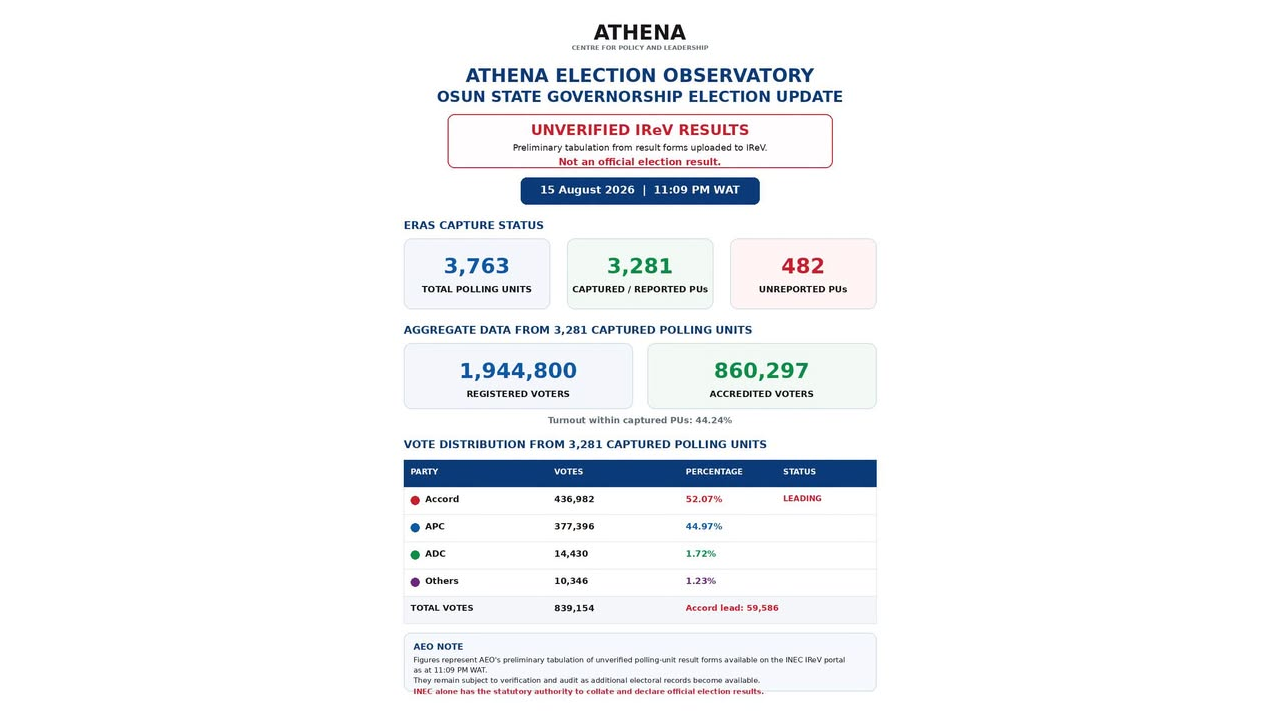
The declared margin of victory expanded from 28,344 votes in 2022 to 66,252. Candidate Ademola Adeleke of the Accord Party won the contest with 511,067 votes, defeating Bola Oyebamiji of the All Progressives Congress (APC), who received 444,815 votes.
The observatory highlighted that active oversight by competing political parties made large-scale electoral fraud significantly harder to carry out.
“Organised political competition is itself an important safeguard for electoral integrity. Where competing political parties possess capabilities at scale including agents across polling units, working knowledge of the electoral process, and the capacity to track results independently manipulating an election becomes much harder to execute without detection,” AEO said.
On technical improvements, the observatory commended INEC’s use of structured digital entries, the Bimodal Voter Accreditation System (BVAS), and real-time result uploads to the INEC Result Viewing (IReV) portal. Together, these tools created a clearer, more traceable record, though the report noted lingering gaps regarding system resilience, transmission timing, upload delays, and record reconciliation.
The observatory confirmed it is moving forward with a full post-election audit to examine the collation process in detail.
“We are not asking who should have won. Voters have voted, and INEC has exercised its statutory responsibility to declare the winner. We are asking a different question: How resilient, transparent, and accurate is the structural chain of collation when subjected to total digital and declared results?” AEO stated.